.avif)
Your Agent Is Only as Good as Your Infrastructure
You built a great agent, but something happened when it moved into production.
In testing, your agent reviewed pull requests efficiently on its own. It read the diff, grepped the codebase for related usages, ran the test suite, checked whether CI was still red from an earlier commit, and drafted a comment—all before you'd finished reading the diff yourself.
In production, however, the same five steps ran behind every other PR review your team's agents performed that hour. Some reviews landed in seconds; others sat for minutes because the test-suite step landed on a node that was mid-burst from someone else's agent.
The agent didn't change. The execution environment did, and that's what decided whether review time held steady or crept up.
Agentic applications introduce a different execution pattern than traditional chat applications. As those workflows become longer and more dynamic, infrastructure has a much larger influence on latency, reliability, and cost than it does for a simple chatbot.
That's why your agent is only as good as your infrastructure.
Agents aren't chatbots with more steps
The difference between serving inference for a chatbot vs. an AI agent isn't simply that one is "more capable." They execute work differently:
- A chatbot usually performs one inference call for each user message. The model receives a prompt, generates a response, and waits for the next user input before proceeding.
- An agent executes the entire workflow, turning one user message into a chain of inference calls. It might decide to search documentation, retrieve data from a database, call an API, execute code, evaluate the result, and then repeat that process before producing an answer. Each of those decisions may trigger another inference call, and every result becomes additional context for the next step.
That execution model changes the infrastructure requirements for AI agents.
One question, many steps behind it
Instead of optimizing for individual inference requests, the system has to support long-running workflows whose latency and reliability depend on every component in the chain.
A single user request often expands into a sequence of inference and tool execution steps, sometimes called multi-turn tool calls or the agentic loop. Rather than generating one response, the model alternates between reasoning and interacting with external systems.
Here's what that workflow looks like.
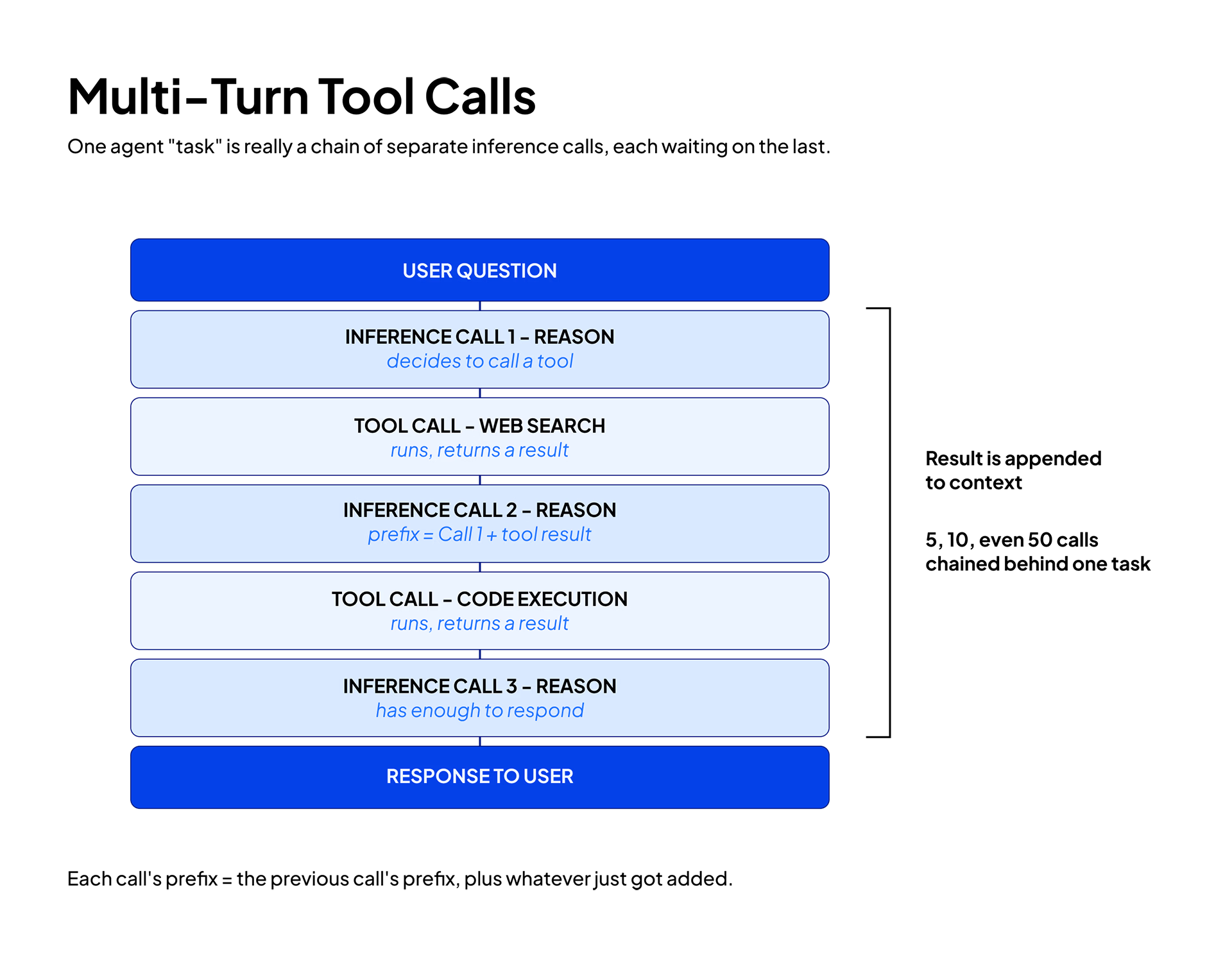
For example, you ask an agent why checkout latency spiked overnight. The agent pulls the deploy log, queries the monitoring system, runs a diagnostic against the connection pool, weighs whether the culprit is a bad deploy or a capacity issue, and then folds that into another inference call before it finally produces a full-fledged response and answers.
Each reasoning step becomes another inference request, and every tool result is added to the model's context before the next step.
This workflow changes what reliability means
Multi-turn workflows are inherently sequential, which is why even low latency can quickly add up to a significant amount. Every inference step waits for the previous one to finish. If a database query takes two seconds, the model can't begin the next reasoning step until that result returns. The model may generate tokens quickly, but the other steps slow it down.
In this agentic workflow, every step in the chain has to hold, because the chain is only as strong as its slowest link. Instead of processing isolated inference requests, the inference stack has to orchestrate a chain of dependent model invocations and external tool calls. As those workflows become longer, the stack increasingly determines how quickly, reliably, and cost-effectively the application performs.
But the user doesn't see an orchestration hiccup. They see an agent that hung, or gave up.
That's why end-to-end reliability for agents depends on much more than model quality. Infrastructure determines whether each step has the resources it needs to execute predictably under load.
Why the bill and the performance both feel unpredictable
There's a second difference with agentic workflows that catches teams off guard: demand pattern and the impact that has on your inference bill.
Most inference services, and the pricing built on top of it, assumes traffic that arrives at a predictable pace. A typical inference solution knows the predictable demand pattern: User traffic increases, request volume increases, and capacity scales accordingly. Cloud infrastructure is typically optimized for these steady request patterns using mechanisms such as autoscaling, load balancing, and capacity planning.
Agent workloads don't behave that way. Individual workflows pause while waiting on external systems, then resume as soon as new information becomes available.
- The pause: The agent waits on an external API or database, so the GPU serving that workflow has no inference work to perform, and its accumulated context may be evicted from GPU memory while it waits
- The burst: As soon as external systems return results, inference resumes simultaneously across many workflows, creating short and sharp spikes in GPU demand, each re-processing its full accumulated context
Think of the graphic above and the "reasoning" patterns for when agents make calls. The infrastructure sits idle during the tool call and spikes while the agent is reasoning.

Inference services designed around steady or predictable request streams can struggle to allocate resources efficiently under these conditions. This leads to inconsistent latency, GPU underutilization, or higher operating costs.
When performance becomes unpredictable or a bill doesn't line up with what you expected, it’s evidence that your infrastructure was built for a different workload than the one you're actually running.
What infrastructure built for agents actually looks like
Agentic applications place different demands on infrastructure than traditional AI workloads: long dependency chains, bursty demand, and continuous evolution. Because of this, the infrastructure is deciding whether the chain holds, and whether the bill holds too.
For an agent to run, it needs infrastructure purpose-built to support:
- Performance that holds across the whole chain. The infrastructure must keep latency consistent across multi-step and multi-tool workflows.
- Scalability that responds to bursty demand. Infrastructure should scale quickly as inference demand fluctuates, without requiring capacity to remain provisioned during idle periods.
- Predictable economics even for dynamic workloads. The infrastructure bill should reflect the actual usage of the infrastructure.
Your agent is only as good as your infrastructure. Get it right, and the responsiveness, reliability, and cost-effectiveness of your agent will impact your work for the better.
This is the first of a three-part series on agentic inference and the infrastructure that powers it. Stay tuned for the next article coming out next Thursday, where we go deeper into the anatomy of an agentic prompt, prefix-aware routing, and KV caching.
Learn more about how infrastructure can be purpose-built for agentic workflows:
- Watch the webinar: Unlock Agentic Breakthroughs with a Purpose-Built AI Cloud
- Read the blog: CoreWeave Closes the Loop Between Training and Inference
- Learn about CoreWeave solutions: How to build AI agents on a foundation of reliability