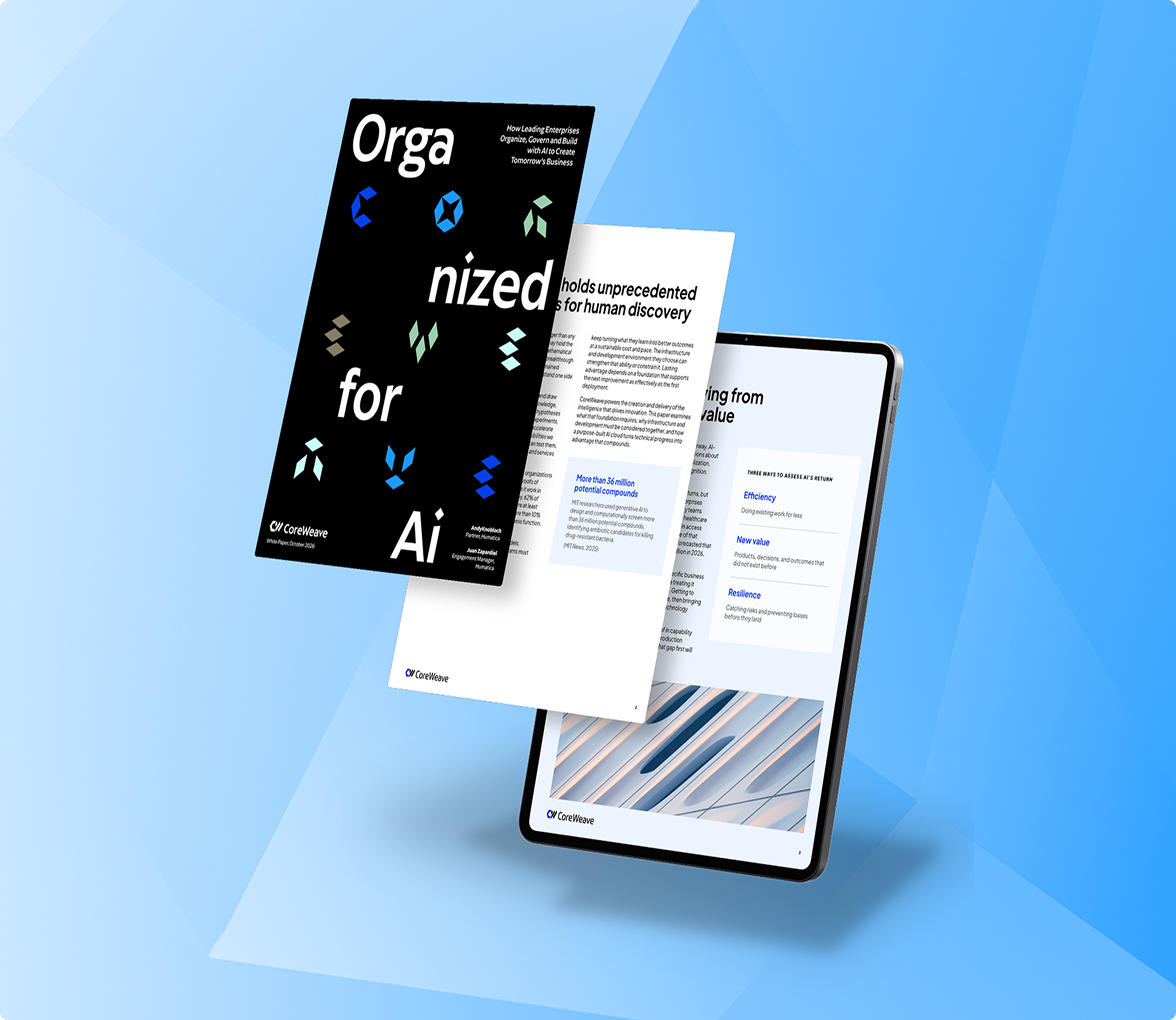
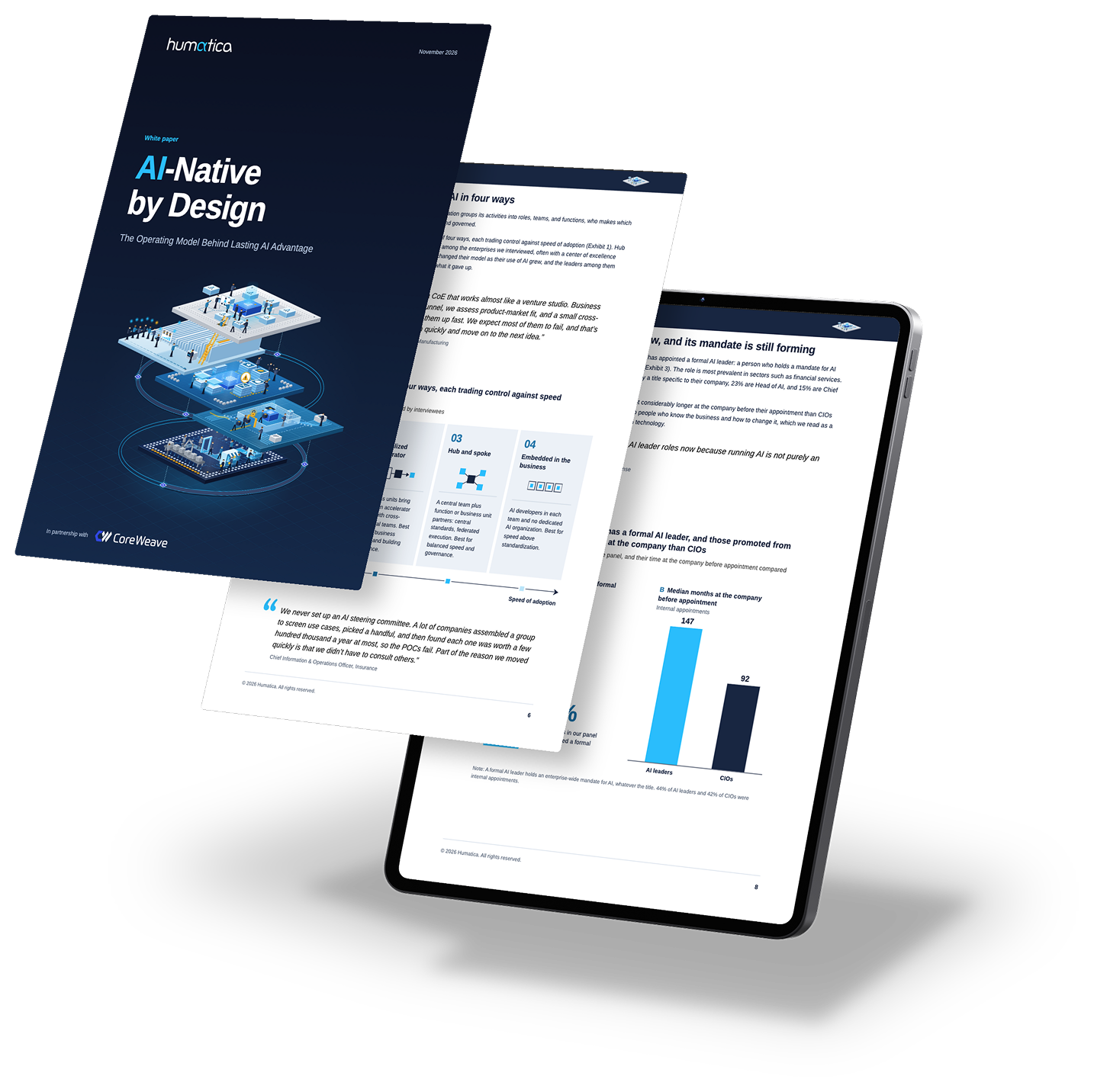
Research by Humatica, in partnership with CoreWeave

AI is already running your business. Who is running the AI?

Most enterprises are adopting AI before they know how to organize, govern, and build with it. This report shows how AI pioneers do all three and which decisions only executives can make.

252
 
Enterprises studied across 14 industries
30+
 
In-depth interviews with senior executives and investors
Jul - Oct 2026
 
Research window
The premise

The models are the same. The organization is not.

Every enterprise can buy the same frontier models. What an organization cannot buy is clarity regarding who chooses what gets built, who owns each system once it runs, and who pays for it. The challenge is that most enterprises depend on AI before they’ve made any of those decisions.

This report, AI-Native by Design, shows where 252 enterprises stand on AI maturity and what the leaders among them do differently.

95%
 

of enterprises studied

Have moved beyond individual experimentation

66%
 

of enterprises studied

Run a process, product, or business model that breaks without AI

20%
 

of enterprises studied

Have appointed a formal AI leader

24%
 

of production AI use cases

Start with no sponsor and no budget

Adoption vs. Maturity

You already depend on AI

Adoption counts tell you how many people use AI. Maturity is what the business depends on AI to do and whether the organization can build, run, and improve it. The riskiest enterprises depend on AI before they can run it, which is why 1 in 8 could not deliver its offer at today’s price without AI.

“AI can take a user from zero to capable very quickly… Building is now only 30% of the work. Everything after that is data, integration, and architecture to operationalize it.”
Chief Digital Officer
Executive Search
Operating model and ownership

Your organization is not built to own AI

AI now does part of the work your roles, handoffs, and approvals were designed around. Most enterprises haven’t reorganized around it. Asked what holds them back, leaders named their own organization more than twice as often as the technology.

1 in 3
 
of enterprises studied

Have a formal AI operating model

2.4x
 
reported by leaders interviewed

More often, the organization is the constraint on AI, not the technology

Building got easier.
Owning did not.

Teams now rely on AI systems that no one clearly owns. The report calls them orphan services, noticed only when they break. To solve this, leading enterprises build security, access, monitoring, and cost controls into a shared platform, so every new use case inherits them.

“If you don’t keep improving your agents once they’re in production, and you don’t put proper governance around them, you end up with an agent wasteland.”
Chief Engineer
Automotive
Control

Advantage comes from the AI you control

Most enterprises buy AI as a service for everyday work, and should. However, competitors using the same models can match those gains. For the workloads they compete on, pioneering teams want control of the systems, data, and knowledge that improve over time.

73%
 
of leaders asked

Named differentiation and proprietary IP as a reason to control a critical workload

36%
 
of leaders asked

Named cost and predictability as the least-cited reason to control a critical workload

What leaders do differently

Five practices to turn AI ambition into lasting value

Most best practices begin with a decision only the executive team can make.

Make AI an operating model decision.

Name an owner for every process and product that depends on it, and tie the investment to the budget holder who answers for the result.

Empower decentralized building, and scale proven results. 

Give the business a shared way to build. Put a stricter gate in front of anything others will depend on.

Unlock the enterprise's knowledge as a proprietary AI advantage.

Expertise that was never written down can now be codified. Curate it, give it an owner, and build on it where the business competes.

Keep control of the AI the business depends on. 

Route work across models by task, cost, and sensitivity. Keep the workloads that matter on infrastructure you control.

Keep every AI production system owned, measured, and improving

Give every system an owner, a feedback cycle, and a retirement date if it stops earning its place.

FREE. NO FORM REQUIRED

Get the full report

Inside you’ll find:

  • The four ways enterprises organize AI, and what each one trades off
  • The AI maturity matrix and the five stages of AI dependence
  • Ten requirements of owning an AI system, and which are new
  • Five options for closing the gap between AI ideas and execution
  • A function-by-function map of how leaders use AI, from productivity to products
  • The five practices in full, plus methodology
FAQ

Questions executives are asking

What is an AI operating model?

Why isn't AI adoption the same as AI maturity?

Who should own AI in the business?

When should an AI workload run on infrastructure you control?

Who produced this research?

LOREM IPSUM

Build and run the AI your business depends on

Talk with CoreWeave about the infrastructure, tools and teams behind production AI, from a first critical workload to a platform the whole business can build on.

Thanks for reaching out to CoreWeave!

This is the default rich text value

About the research

The research behind the report

Who was studied: The study covers 252 enterprises, private equity-backed and family-owned enterprises, across 14 industries in North America, Europe, and Asia. The report excluded AI labs, AI and cloud vendors, startups, and companies with less than $50 million in revenue.

How the study was done: Every enterprise in the panel has an active AI program. Between July and October 2026, Humatica profiled each one from more than 1,900 annual reports, filings, and investor documents. It also interviewed 30+ chief executives, AI and digital officers, CIOs, and investors. Every data point is sourced and independently reviewed, and quotes are credited by role and industry.

AUTHORS
Andy Knobloch
Partner, Humatica

Juan Zapardiel
Engagement Manager, Humatica

Humatica logo

Humatica is a specialist advisor on organizational transformation, with more than 500 organizational effectiveness projects completed for private equity funds, their portfolio companies and large enterprises. Offices in London, New York, Munich, Paris, Zurich and Singapore.

CoreWeave

CoreWeave is The Essential Cloud for AI™. Built for pioneers by pioneers, CoreWeave delivers the technology, tools and teams that let innovators build and scale AI with confidence. Trusted by leading AI labs, startups and global enterprises.