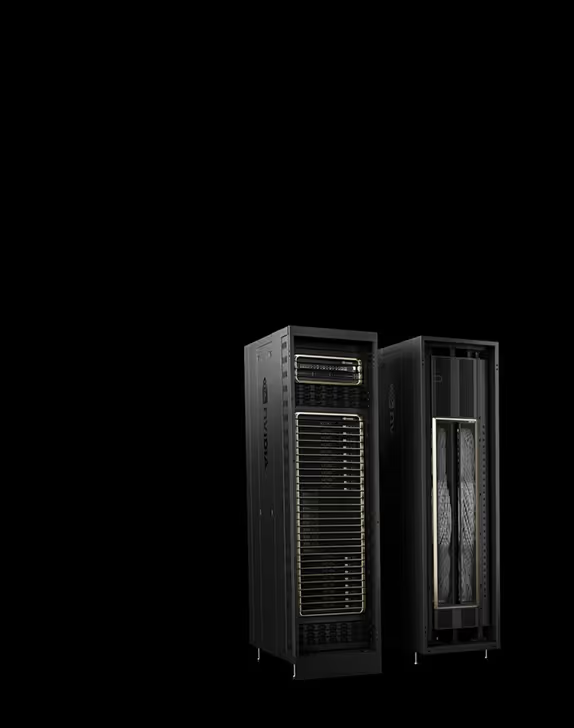
The rise of artificial intelligence has created a new class of infrastructure provider: the AI hyperscaler. While traditional cloud platforms were built to serve a wide mix of applications such as web hosting, enterprise IT, storage, and more, AI hyperscalers are engineered from the ground up to meet the extreme demands of modern machine learning.
Training today’s state-of-the-art AI models isn’t just about having “a lot of compute.” It requires data centers purpose-built with higher-voltage racks, specialized power systems, liquid cooling, such as direct-to-chip cooling, for tens of thousands of specialized GPUs or custom accelerators working in concert, high-performance networking fast enough to keep those chips in sync, and storage systems capable of feeding petabytes of data without bottlenecks. On top of that, AI hyperscalers must deliver these resources elastically, scaling from a handful of GPUs for model fine-tuning to entire supercomputer-scale clusters for foundation model training, all while keeping costs and efficiency in check.
In other words, AI hyperscalers aren’t just larger versions of the cloud as we know it. They represent a purpose-built evolution of cloud infrastructure, tuned specifically for the speed, scale, and complexity of AI. They’re the platforms that make trillion-parameter models feasible, power real-time global inference, and ultimately enable the next wave of AI breakthroughs.
AI hyperscalers vs. traditional cloud providers
At first glance, hyperscalers and general cloud providers look similar. Both operate massive data centers, deliver elastic cloud computing services, and support customers around the globe. But their design priorities diverge.
Traditional cloud platforms were built to handle a wide variety of workloads, whether it’s hosting websites and databases or running Enterprise Resource Planning systems and analytics pipelines. AI hyperscalers, by contrast, focus on the compute-heavy, latency-sensitive needs of AI. Their infrastructure is tuned for large-scale training runs and real-time inferencing, not just general IT workloads.
The table below highlights the key differences:
Key features and benefits of AI hyperscalers
What truly defines an AI hyperscaler isn’t the sheer size of its infrastructure, but how every layer is tuned specifically for artificial intelligence. Unlike general cloud platforms that scale broadly, hyperscalers are engineered from the ground up to meet the unique speed, scale, and complexity of AI.
For organizations building or deploying advanced models, these design choices translate directly into practical advantages:
Massive compute clusters
Tens of thousands of GPUs or accelerators work in sync to power large-scale training and inference.
Why it matters: Without this level of scale, trillion-parameter models or global inference services would remain out of reach.
Elastic scaling
Capacity can grow or shrink with demand, from fine-tuning on a small set of nodes to training foundation models across entire clusters.
Why it matters: Businesses only pay for what they need and can scale instantly when projects ramp up.
High-performance networking
Low-latency interconnects keep thousands of processors operating as one cohesive system.
Why it matters: Bottlenecks are removed, enabling both distributed training and real-time inference without lag.
AI-optimized storage
High-throughput systems are tuned for massive training datasets, model checkpoints, and embeddings.
Why it matters: This ensures data moves as fast as the compute, preventing slowdowns that could stall entire jobs.
Integrated AI software stack
Frameworks, such as PyTorch and TensorFlow, come pre-tuned, alongside inference servers and orchestration tools.
Why it matters: Developers spend less time managing infrastructure and more time shipping AI applications.
Operational efficiency
Cooling systems, workload scheduling, and energy optimization are engineered specifically for hyperscale AI.
Why it matters: This supports cost efficiency at scale and helps address sustainability concerns around energy use.
Lower operational overhead
Organizations interact with resources through APIs and cloud dashboards rather than maintaining physical hardware.
Why it matters: IT teams are freed from managing infrastructure headaches and can focus on higher-value work.
In short, AI hyperscalers don’t just provide more infrastructure; they provide the right infrastructure that’s tuned for the realities of modern AI.
Common challenges with AI hyperscalers
Building and operating infrastructure at hyperscale brings enormous advantages for AI, but it also introduces new pressures that smaller-scale systems rarely face. When you’re orchestrating tens of thousands of GPUs, moving terabytes of data per second, and serving predictions to millions of users, even small inefficiencies ripple into big problems. Some of the most common hurdles include:
- Scaling resources: accessing large pools of GPUs can be challenging, as demand often spikes when organizations deploy inference at massive scale
- Complex operations: running distributed training across thousands of nodes requires deep expertise and robust orchestration
- High cost of scale: inference may be lighter than training, but at global scale, it can become one of the biggest ongoing expenses
- Sustainability concerns: large AI data centers consume enormous amounts of energy, raising environmental questions
- Lock-in risk: deep integration with one provider’s software stack can make switching vendors difficult
Recognizing these challenges helps organizations plan their AI strategies with open eyes.
How AI hyperscalers are used in practice
The emergence of the AI cloud has reshaped how industries approach innovation. Instead of building expensive in-house clusters, organizations now tap hyperscalers for on-demand access to AI infrastructure.
Some current use cases include:
- Generative AI (GenAI): delivering foundation models like OpenAI’s ChatGPT or Stability AI’s image generators to millions of users with real-time, low-latency inference
- Healthcare: powering companies to run large-scale speech-to-text and clinical language models that support doctors with faster, more accurate documentation and diagnostics
- Autonomous systems: training and deploying simulation and perception models that help self-driving cars, drones, and robotics make split-second decisions in complex environments
- Finance: enabling firms to run advanced risk modeling and fraud detection models that process thousands of transactions per second
- Scientific research: supporting breakthroughs in climate science, physics, and drug discovery by giving researchers access to hyperscale compute clusters that dramatically reduce training times
These examples illustrate the real-world impact of AI hyperscalers: They make it possible to move ideas from lab experiments to production systems that serve millions of people.
Looking ahead: the future of AI hyperscalers
AI hyperscalers aren’t just keeping pace with today’s demands; they’re setting the stage for the next era of computing. The direction is clear: larger models, faster infrastructure, and smarter deployment strategies.
Trends to watch:
- Blended architectures
Centralized clusters won’t disappear, but they’ll increasingly be paired with inference at the edge. From autonomous vehicles to connected factories, hyperscalers will need to support systems that operate seamlessly across both worlds.
- Smarter, greener infrastructure
The energy footprint of hyperscale AI is under the microscope. Expect rapid advances in cooling systems, networking standards, and workload scheduling to make large-scale AI more efficient and sustainable.
- Breakthrough hardware and connectivity
Faster interconnects and new classes of accelerators will continue to push boundaries, cutting costs for inference while enabling ever-larger training runs.
What this means for businesses
The smartest organizations won’t treat hyperscalers as a substitute for their own AI capabilities but as a force multiplier. Internal teams provide the ideas, data, and domain expertise. Hyperscalers provide the scale to turn those ideas into production systems that reach millions. The relationship between the two is evolving into a partnership that defines competitive advantage in the digital economy.
The future of AI isn’t a solo effort. It’s a collaboration between enterprises building the “what” and hyperscalers enabling the “how.” The real question is: How will you use that scale to shape what comes next?